
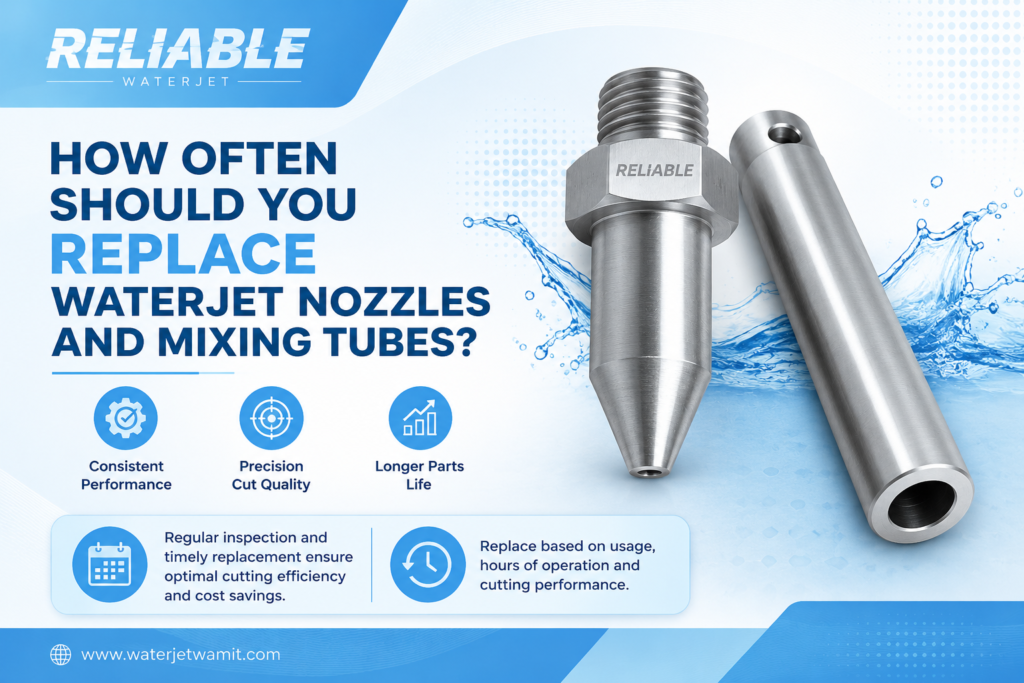
If your Wamit Waterjet cutting machine is creating rough edges, tolerances that are out of specification, or unexpected tapers, your nozzle or mixing tube is likely the cause. The two parts are silent and constant-running components. Most operators don’t replace them in time, before the quality has degraded and the garnet has been used up.
Whether you’re operating a Wamit Waterjet Metal Cutting Machine, a Wamit Waterjet Stone Cutting Machine, or a Wamit Waterjet Glass Cutting Machine, this guide provides precise replacement intervals, warning indicators, and beneficial tips for ensuring the longest possible life from your wear parts.
What Do Nozzles and Mixing Tubes Actually Do?
Before understanding why these parts wear out, it’s important to understand what they do under pressure. The orifice (jewel nozzle) is a tiny precision gem — ruby, sapphire, or diamond — that converts ultra-high-pressure water (up to 60,000 PSI) into a coherent, pencil-thin stream. Every second it operates, water traveling at nearly 900 m/s passes through a hole smaller than 0.4 mm.
The mixing tube (focusing tube) is where abrasive garnet is drawn into that stream and the cutting jet is fully formed. Like all abrasive waterjet systems, the mixing tube is the hardest-working part of the China Water Jet Cutting Machine Wamit — garnet particles flying at high speeds eat away at it from the inside.
Key principle: The nozzle and mixing tube wear at similar rates. When you replace one, replace the other. Running a new orifice with a worn mixing tube (or vice versa) wastes the new part and produces inconsistent results.
How Long Do They Typically Last?
Orifice / Jewel Nozzle
- The lifespan is highly dependent on the jewel material:
- A ruby or sapphire orifice requires 40-80 hours of cutting time.
- Diamond orifice: 800 – 1000+ hours — much more expensive, but most cost-effective in high-volume shops that are open 8+ hours a day.
Mixing Tube (Focusing Tube)
- High-speed steel: 20–40 hours
- High-quality composite carbide (Roctec-style): 50–100 hours
- Cutting hard materials (granite, titanium, thick stainless): reduce these estimates by 30–40%
Important: These are cutting hours, not clock hours. A 4-hour machine on an 8-hour shift will have replacement intervals in about 2 times the calendar time.
5 Signs Your Nozzle or Mixing Tube Needs Replacing
Don’t wait for dramatic failure. These are early signs that precede the point of visible poor cut quality, which saves garnet, machine time, and rework.
- Edges are rougher than usual — with no change in your settings, garnet grade, or material. The flow of the stream is becoming less coherent.
- Taper is getting worse — parts that used to cut perfectly straight now have an angled edge. As the tubes wear out, the stream spreads out.
- Garnet consumption is climbing — you’re using more abrasive to achieve the same cut quality as before.
- The cutting stream appears wider or less concentrated—it can be seen when operating the machine without material in it; the stream widens rather than staying compact.
- Dimensional drift — Parts are slightly off-size from your DXF even with the kerf compensation set.
Replacement Intervals by Material
Material hardness is the single biggest factor affecting wear part life on any Water Jet Cutting Machine Wamit. Use this table as your baseline guide:
What Makes Wear Parts Fail Faster?
There are several factors that can be controlled by you that contribute to the wear of your nozzle and mixing tube. Knowing about them can make a real difference to the life of your waterjet cutting WAMIT manufacturer machine.
- Garnet quality is poor; the particles in the garnet are not all of the same size, which leads to an uneven wear pattern inside the mixing tube.
- Hard water — mineral deposits build up on the orifice and disrupt the stream’s coherence
- Standoff is too close to the material – causes backwash that erodes mouth of the tube
- Running at maximum pressure when it is not required — cutting soft materials at 60,000 PSI, when 45,000 PSI would suffice, causes unnecessary wear of the orifices.
- Ignoring early warning signs – allowing the worn tube to run until it breaks, causing secondary damage to the cutting head
| Material | Orifice Life | Mixing Tube Life | Notes |
| Aluminium / mild steel | 60–80 hrs | 80–100 hrs | Standard workload |
| Stainless steel | 50–70 hrs | 60–80 hrs | Wamit Waterjet Metal Cutting Machine |
| Granite / marble | 40–60 hrs | 50–70 hrs | Water Jet Cutting Stone — highly abrasive |
| Titanium / Inconel | 30–50 hrs | 40–60 hrs | Hardest metals — inspect frequently |
| Glass (standard) | 60–80 hrs | 70–90 hrs | Wamit Waterjet Glass Cutting Machine |
| Rubber / foam | 80–100 hrs | 100–120 hrs | Lowest wear; water-only cutting possible |
How to Extend Wear Part Life
Switch to diamond orifices
With a 6+ hour cut, the ROI on diamonds vs. sapphires is earned within weeks. A diamond orifice at 10 times the initial price works 10-20 times longer — simple numbers for high-volume shops.
Filter your water
A simple water softener or inline filtration system will clean out the minerals that clog the orifice from the inside. Low-cost insurance on high-dollar precision parts.
Log cutting hours per head
Keep a simple maintenance log per cutting head. A spreadsheet that includes the date and start and end hours per head takes 30 seconds per shift and makes proactive replacement simple.
Stock spares on-site
A worn nozzle should never put an end to production. Store a minimum of two sets of wear parts per machine. The wait time for a machine to deliver adds up quickly.
Match pressure to material
Apply pressure only as is needed for the material. Reducing PSI on foam or rubber cuts down on wear part life without increasing the quality of the cut.
Inspect the stream visually once per shift
A quick 10-second visual inspection of the cutting stream will detect tube wear before it becomes evident in the completed cuts and necessitates rework.
The Real Cost of Waiting Too Long
It’s tempting to squeeze extra hours from a worn mixing tube. The actual costing can be quite different when all factors are taken into consideration. A worn tube on an 8-hour-per-day Wamit Chinese waterjet machine will use 20-30% more garnet than a new tube (since it requires more stream of garnet to achieve the same cut quality).
With a normal garnet cost, the waste is more expensive than the cost of replacing the mixing tube in just a few days of use. Include rework costs for tolerance out-of-scope or surface finish off-spec — and it is never the “higher” cost.
Rule of thumb: Replace your orifice and mixing tube together every 40–80 hours for standard materials. If it is hard material (stone, titanium), check at 30 hours. If cutting time is greater than 6 hours per day, use a diamond orifice
Not Sure If Your Cuts Are Where They Should Be?
Send us your job spec and material. At WAMIT Waterjet Cutting, we will determine if your current results are comparable to a maintained machine.
