
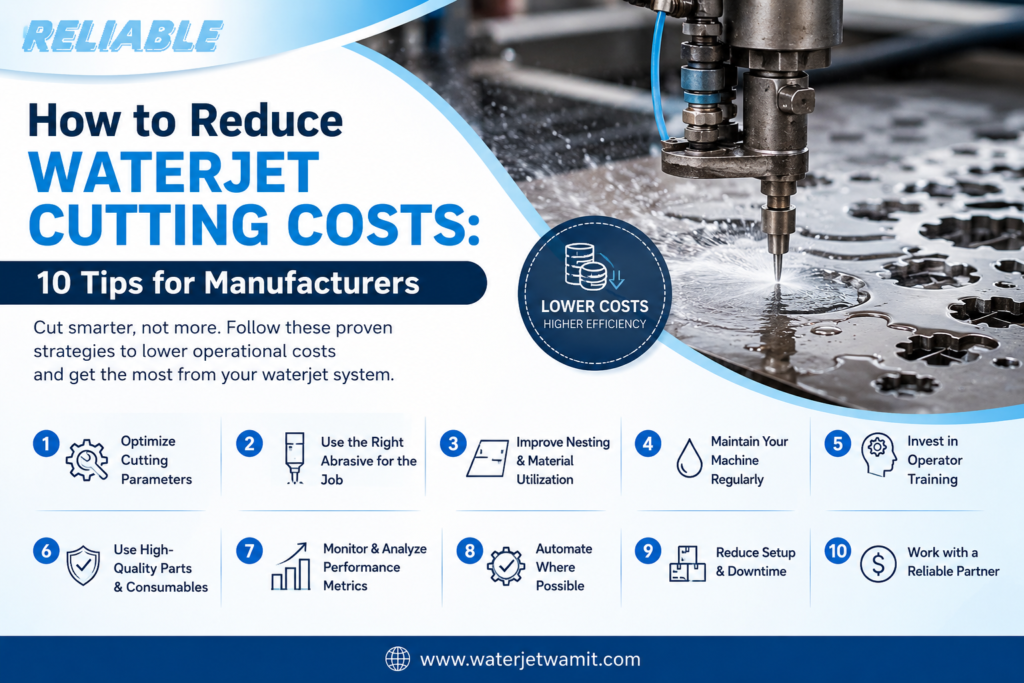
Most manufacturers know what waterjet cutting costs per hour. Few are aware of where that money is really going to or how much is quietly leaking away through bad habits, battered parts, and ineffective constructions. It is that difference between knowing the price and knowing the cost that margins fade away. If your production is based on waterjet cutting, then even a 15-20% cut in operating costs can save thousands of dollars a year – without purchasing new equipment. All you require is smarter decisions on the shop floor.
The following are 10 tips to practice that are put together for manufacturers who want to run lean.
1. Optimize Your Nesting Layout
One of the most silent budget killers in the operation of waterjets is poor nesting. When the parts are not arranged efficiently in a sheet, the machine travels more, burns more abrasive material, and wastes material that can be used. High-tech nesting software takes sheet usage to 95%, and in high-volume stores, it alone saves tens of thousands of dollars annually.
2. Match Abrasive Grade to the Job
Abrasive garnet consumes 30-50 percent of all waterjet cutting operating expenses – but many shops overlook how much it affects their expenses. Apply 80-mesh to thick metals where speed matters and 120-mesh to thin metals or precision work. Using high-quality abrasives on average cuts is a waste of money. Correlate grade and job requirement, and that is all.
3. Replace Mixing Tubes on Schedule
A worn mixing tube silently increases the water jet cutting expenses. With the expansion of the inner diameter, the abrasive flow rises, and cutting efficiency decreases – double hits on your budget. Measure tube ID once a week. Change when the wear is more than 0.1mm. Serving a tube of abrasive costing 120 USD out of pocket out of service longer than its useful life indicates a higher cost in wasted abrasive and parts rejected than in the replacement itself.
4. Stop Over-Specifying Tolerances
When the demand of the design teams exceeds the actual requirement of the application, the machine slows down, abrasive use increases, and machine time is wasted, with zero functional gain. Inquire before every job: is it a real need of this part, or will it work in the same manner in assembly with a ±0.015 inch need? One of the quickest, least expensive methods of decreasing per-part cost is to adjust tolerance specifications.
5. Run Preventive Maintenance – Not Reactive Repairs
Avoiding regular maintenance does not save time; it simply shifts little expenses to big expenses. Unplanned waterjet downtime can be costly in terms of lost production, at an estimated cost of more than $200 per hour. A regular schedule of daily walkarounds, weekly inspections, and monthly seal and orifice checks ensures machines are efficient and unwanted surprises are not found on your quarterly books.
6. Calibrate Cutting Pressure Per Material
Operating all jobs under maximum pressure reduces the life of components and increases energy bills. The majority of the materials can be cut in the range of 50,000 to 60,000 PSI. Increased pressure must be a controlled appeal to each material, not a lasting default. Seal and orifice wear are minimized, with power costs manageable over long shifts, and pressure per job calibrated.
7. Batch Similar Jobs Together
The setup costs are fixed overhead that is most damaging when allocated over too few parts. It might actually cost $120 apiece to set up ten little jobs individually; when they are batched, that cost can be reduced to about 18 per job. Organize by type of material and thickness wherever you can fit it in your schedule. Reduced changeovers, increased productive cutting time, reduced cost/part.
8. Store Abrasive Properly
Garnet clogs damaged by moisture feed lines disrupt flow and cause operators to run higher rates or scrap parts altogether. Damage is usually not noticed until the quality of cuts fails. Store garnet in closed containers, off concrete floors, and rotate stock so that older garnet is used up first. An easy habit that ensures your biggest line-item expense.
9. Use Software to Track Abrasive in Real Time
Recent waterjet systems are compatible with closed-loop metering of abrasives, i.e., automatically adjusting the garnet flow, depending upon the material and cutting conditions. This can avoid excessive consumption during stable cuts and can identify nozzle or pump problems before they get out of control. When your system has it and you are not using it, you are losing money each shift.
10. Choose the Right Machine Partner
The long-term cost of waterjet cutting is not in the purchase price but in uptime, consumable efficiency, and service reliability. A machine with 95% uptime compared to 80% has radically different economics over five years. When considering partners, look beyond the hourly rates and inquire about the total cost of ownership, part availability, and response times.
Conclusion
It is not about reducing standards to cut the costs of waterjet cutting but about eliminating waste at each stage. Abrasive selection and nesting, maintenance schedules, and pressure settings are just some of the tips that your team can put into practice.
As a company, Shenyang Reliable Technology provides in-depth knowledge of the waterjet cutting systems and helps manufacturers to reduce operating costs without affecting the precision or output quality. They offer high-quality waterjet machines that are designed to last longer in manufacturing functionality.
Call Shenyang Reliable Technology today and have your waterjet cutting operation work harder on your bottom line.
FAQs
What is the highest ongoing cost in waterjet cutting?
Abrasive garnet – generally, 30-50% of total operating costs, depending on flow rate, mesh size, and nozzle condition.
What would be the frequency of mixing tube replacement?
Weekly check ID; change when wearing more than 0.1mm. With normal operating conditions, most tubes have a life of 60 or more hours.
Does the speed of cutting influence the operating costs?
Yes. Reduced speeds have a more aggressive per-inch cut that has a direct impact on cost per part. The speed must always be adjusted according to the material.
