
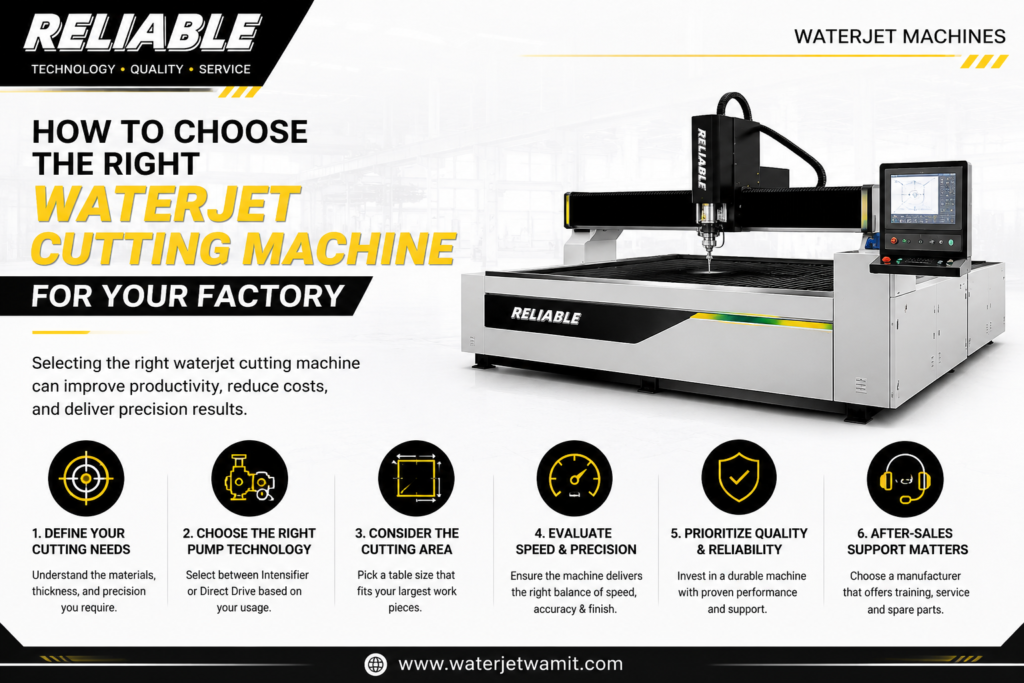
A factory owner will only realize the true benefits of a cutting system when production starts to slow down. Missed orders, jagged edges, waste, increased maintenance expenses, and downtime can cost profits lost each month. That’s why it’s no longer simply about machine specs and size when purchasing a cutting solution. It is choosing equipment that will help ensure consistent production, lower operating costs, and increased productivity over the long run.
Manufacturers are increasingly choosing a modern waterjet cutting machine for cutting various materials, which allows for cutting various materials without heat damage and guarantees accuracy. But not all machines will be appropriate for all factories. Some businesses require rapid production, and others require flexibility in their work with custom projects. The wrong system can cost more to operate than to be efficient.
This guide provides an in-depth look at the primary considerations that every industrial buyer needs to pay attention to when investing in a water jet cutter.
1. Start With Your Material Requirements
All choice decisions start here. A waterjet cutting machine is available in two modes: Pure waterjet cutting and abrasive waterjet cutting. Pure waterjet is more effective on soft materials such as foam, rubber, food products, and thin plastics, and is made up of only high-pressure water. Abrasive waterjet cutting introduces garnet into the stream, enabling it to cut through hard materials like metals, ceramics, glass, composites, and stone.
When you are regularly working with steel plates, titanium sheets, or aluminum blocks, you’ll want a machine that is designed for abrasive waterjet cutting. If it is not done correctly from the beginning, it is prone to frequent workarounds, slow turnaround, and poor edge quality.
2. Pump Pressure: The Core of Performance
The pump is the soul of the waterjet cutting machine. There are two types of pumps available in the market:
- Intensifier pumps use hydraulic pressure to push water up to 90,000 PSI. They are ideal for continuous, heavy-duty operations.
- The direct-drive pumps operate with crankshaft-driven plungers. They’re less noisy, less complicated to maintain, and more appropriate for periodic cutting programs.
Generally, higher pump pressure results in faster cutting speeds and better performance on thick materials. In most industrial factory applications, a pump that runs over 60,000 PSI gives the highest speed and precision. Pressure surges are to be avoided; they result in inexact cuts and affect the final surface.
3. Cutting Table Size and Machine Configuration
Your factory floor space and part dimensions will determine the table size you need. They can be as small as 2×2 m for small workshops to 6×3 m for large-format production.
In addition to size, look at the axis configuration also:
- For most fabrication shops, 3-axis machines are ideal for cutting flat sheets and standard contours.
- 5-axis machines offer the added flexibility to make bevel cuts, tapered holes, and complex angular profiles. Many parts do not require a secondary milling process.
For custom-formed parts or precision aerospace parts, the 5-axis waterjet cutting machine may be a worthy investment.
4. Operating Costs Matter as Much as Purchase Price
The initial investment is only one piece of the long-term operating cost. Average operating costs are $15-50/hour and can vary based on:
- The biggest variable expense is abrasive use (garnet).
- Nozzle and mixing tube replacement intervals
- Consumption from high-pressure pumps for electricity.
- Local disposal and water use rules
Recycled abrasive systems can reduce garnet usage by up to 50%. Determine your probable monthly machine hours before you look at quotes from various manufacturers and complete an accurate total cost of ownership analysis.
5. After-Sales Support and CNC Software
Your water jet cutting machine is only as reliable as your support. Evaluate manufacturers on:
- Availability of spare parts and consumables
- Quality of CNC control software (ease of programming, nesting efficiency)
- Technical support response time
- Training for operators at the time of installation
Over time, the modern CNC software, featuring AI-optimized cutting paths and predictive maintenance, not only diminishes downtime but also boosts output quality. This is increasingly a standard expectation in industrial procurement.
Conclusion
A waterjet cutting machine is an asset for your factory – and an incorrect specification can cost you years of productivity and unnecessary operating costs. Match the machine with your materials, check the pump performance, determine the size of the cutting table for actual production, and always estimate the total ownership cost and not just the sticker price.
Shenyang Reliable Technology provides the best precision-engineered waterjet cutting machine with solid industrial experience. Their machines are designed for tough factory environments, have powerful CNC control and pump performance, and offer comprehensive after-sales support.
FAQs
How does a pure water jet differ from abrasive water jet cutting?
A pure waterjet can be used with water only and is only suitable for soft materials. Abrasive waterjet cutting adds garnet to the stream, enabling it to cut hard materials like steel, titanium, and ceramics.
How thick can a waterjet cutting machine cut?
Modern machines can cut up to 200mm thick steel, but the cutting speed drops rapidly as the material thickness increases. The two most important variables are pump pressure and abrasive flow rates.
What is the hourly average operating cost of a waterjet cutting machine?
Abrasives, power, consumables, and maintenance, depending on material type and machine pressure settings – operating costs range from $15 to $50 per hour.
