
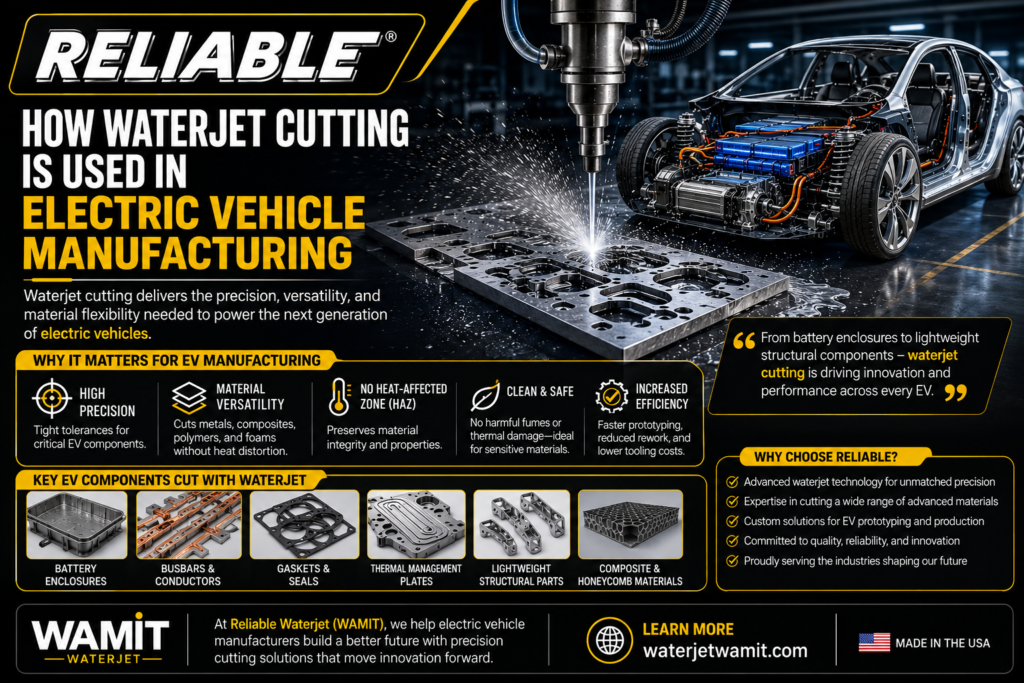
Electric vehicles require extreme manufacturing precision. A battery enclosure that is off by a fraction of a millimeter can compromise thermal management. A structural panel processed with heat-based cutting methods risks material distortion – visible not in the factory, but later on the road. As EV production volumes increase, manufacturers are finding that not every cutting technology meets these demands.
±0.1 mm – Cutting Tolerance Across All EV Materials
Zero HAZ – No Heat-Affected Zone On Any Cut Component
5 Key – EV Component Categories Processed by Waterjet
Cutting Battery Enclosures Without Compromising Structural Integrity
The battery pack is the most critical and most expensive component of any electric vehicle. Its enclosure must seal completely, handle thermal stress, and meet safety certifications that allow zero deviation. Most EV battery enclosures are produced from high-strength aluminum alloy. Here is where waterjet cutting holds a clear advantage over alternative methods.
- Laser & Plasma Cutting: Apply heat that distorts the grain structure of aluminum – micro-distortion.
- Waterjet Cutting: High-pressure water + garnet grit. No heat. No structural change. No change in the properties of the material.
This is no small distinction for parts that need to pass EV safety testing. It’s the difference between an acceptable component and a rejected component.
Technical note: Abrasive waterjet processing involves pressures between 60,000 and 90,000 PSI with tolerances of ±0.1 mm for aluminum, composites and multi-layer laminates – often with little or no secondary finishing operations needed.
Carbon Fiber Body Panels: Where Other Methods Fall Short
Weight reduction is a key focus when designing EVs. Reducing the weight of the body shell increases EV range. Carbon fiber reinforced polymer (CFRP) is now widely used for body panels, roof panels and aerodynamic parts in advanced electric vehicles (EV).
The use of carbon fiber presents major challenges for manufacturers. Here’s the breakdown of the three primary cutting techniques:
| Cutting Method | Heat Generated | Carbon Fiber Safe? | Edge Quality |
| Laser Cutting | High – smokes resin, toxic fumes | No | Scorched edges, rework required |
| CNC Routing | Friction heat, hazardous dust | No | Risk of delamination, quick tool wear |
| Waterjet Cutting | None – cold-cut process | Yes | Clean edges, minimal post-processing |
Waterjet cutting is the only cold-cutting process that removes material from carbon fiber without thermal damage – matrix is not damaged, delamination risk is eliminated, and edges are ready for assembly.
The Non-Metal Components That Also Require Waterjet Precision
To build electric vehicles (EVs), there are many non-metal components that procurement managers don’t think about. Thermal interface materials, gaskets between battery cells, seals between battery modules – all these must be cut with precision from materials that would burn or deform when laser cut.
All of these can be cut with a waterjet cleanly, consistently, without burn, debris or distortion. For multi-shift production facilities, that consistency directly reduces material scrap and improves yield rates.
Key EV components produced with waterjet cutting:
- Battery Enclosure Panels: Aluminum and stainless frames with zero thermal distortion
- Carbon Fiber Body Sections: Structural panels, roofs, and aerodynamic components
- Thermal Interface Gaskets: Cell isolation pads and module-to-module sealing materials
- Copper Busbar Blanks: Power distribution components in battery management systems
- Firewall Insulation: Interior composite trim and thermal barrier layers
- Structural Mounting Frames: High-tolerance frames that attach battery packs to chassis
No Tooling. Fast Design Changes. Production-Ready Output.
EV platforms are still changing at a fast pace. A manufacturer that uses tooling-heavy cutting processes loses production time on every design revision. Waterjet cutting requires no hard tooling — designs transfer directly from CAD files to the cutting system.
A new geometry can be in production within hours of a design update being approved.
No tooling cost on design changes — CAD-to-cut in hours
±0.1mm tolerance maintained from prototype to full production batch
Handles material thicknesses from thin films to heavy-gauge aluminum frames
Equally suited to 10-unit prototype runs and thousands of units per shift
For B2B operations balancing design agility with cost control, this is a measurable operational benefit — not a feature that exists only in ideal conditions.
Conclusion
Electric vehicles require nothing less than precision in their components – it is not an option. Waterjet cutting provides that precision consistently, on the toughest materials in EV manufacturing, with no heat, fumes, or distortion to the material.
If you’re sourcing or processing components for electric vehicle (EV) production, Shenyang Reliable Technology offers industrial-scale waterjet cutting services for B2B customers seeking reliable, production-grade products. Reach out and invest in a long-lasting procurement relationship.
FAQs
What makes waterjet cutting better than laser cutting for EV batteries?
Waterjet cutting is a cold-cutting process and avoids heat distortion in battery components made of aluminum and composites. Laser cutting creates heat, which can change the properties of the material at a molecular level.
Can waterjet cutting process the thick aluminum used in EV structural frames?
Yes. Abrasive waterjet systems accurately cut several inches of aluminum with precise tolerances while avoiding edge distortion and internal stresses.
Is waterjet cutting cost-effective for high-volume EV production?
For intricate shapes or heat-sensitive materials, it lowers scrap and most post-processing costs – making it a more economical choice for most EV components.
Does waterjet cutting help meet EV sustainability goals?
Waterjet cutting is a clean, non-toxic, non-heat-emitting process that generates little waste – all in line with the environmental production standards most EV manufacturers must adhere to.
