
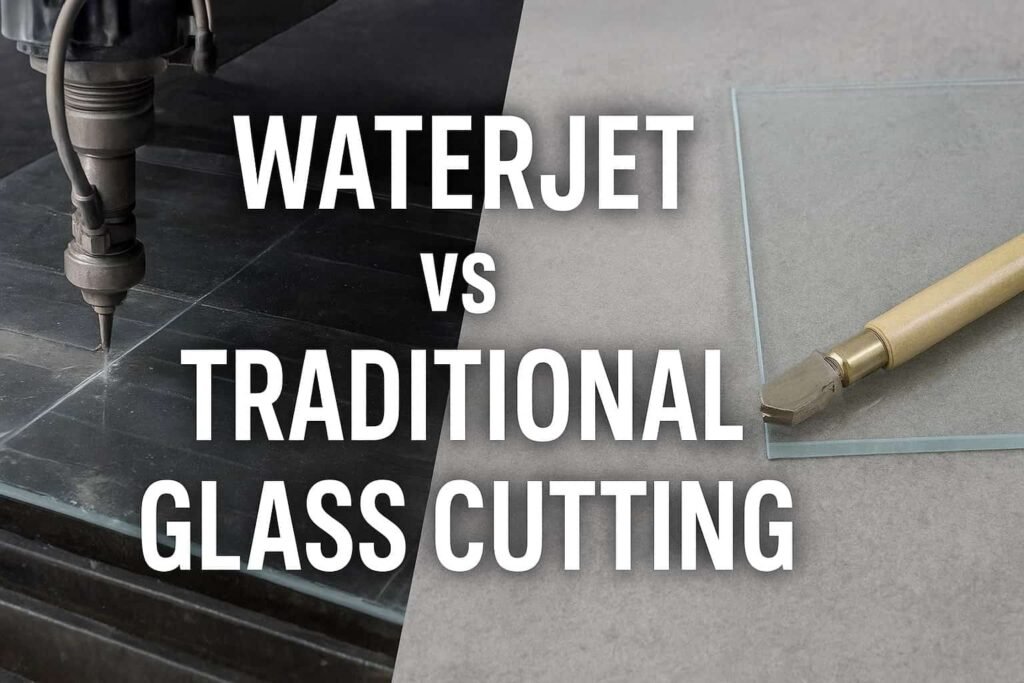
Glass cutting is relevant to many individuals, large factories, as well as artists and DIY hobbyists. It is important to get the cut right to save time, prevent wastage and make the glass look good.
Glass can be cut in two different ways: traditional cutting and waterjet cutting. The older method is traditional cutting, which is applicable in simple straight cuts. Waterjet cutting is more recent and involves using high pressure water to cut glass in a smooth manner even in challenging forms. In this blog we will get to know about Waterjet vs Traditional Glass Cutting method and understand how each method will help you for your project.
Understanding Glass Cutting Methods
Waterjet Glass Cutting
Waterjet cutting is a new technique that involves the use of high-pressure water that is combined with small particles of abrasive to cut glass. It does not need to be scored or snapped and can cut very accurately.
The waterjet cuts glass by spraying a high-pressure water on the surface, which cuts the glass smoothly along the path. There is no heat involved in this process and so there are no cracks or warping.
Waterjet cutting is ideal with fine designs, big projects and industry. It gives clean edges and provides a consistent result thus it is more efficient at more complex projects than conventional cutting.
Traditional Glass Cutting
The old and tested traditional way of cutting glass is still in use. It is done by scoring the glass and then cracking it along the line. This technique relies much on the ability of the individual who cuts the glass.
The usual equipment used in traditional cutting includes glass cutters, scoring equipment, manual pliers, and straight edges. They are less expensive, and good for small projects or DIY.
Still, traditional cutting has limitations, It is most suitable in straight cuts and easy shapes. Thick glass or intricate shapes are hard to cut and the edges are not always smooth.
Comparing Waterjet and Traditional Glass Cutting Methods
Precision and Accuracy
One of the prime distinctions between waterjet and traditional glass cutting is precision. Waterjet cutting leaves very smooth, almost polished edges although traditional cutting may leave rough or chipped edges where the material is much thicker.
Waterjet cutting also comes in handy when it is necessary to form complex shapes. It can handle curves, patterns and detailed designs. Conventional cutting, however, is suitable for straight lines and simple shapes and cannot handle complex shapes well.
The other benefit of waterjet cutting is consistency. It is able to make the same cut many times with high accuracy, this is what makes it ideal to use in industrial projects or in any activity where precision is important.
Speed and Efficiency
Conventional glass cutting is time-consuming and, when it comes to large or complex work, it is also slower. It requires skill and manual effort to achieve accurate results.
On the other hand, waterjet cutting has a constant speed regardless of the design involved. It is highly automated and therefore minimizes errors, saves time and can effectively undertake single custom work as well as the large production work.
Material Waste and Cost Efficiency
Waterjet cutting generates a smaller amount of breakage and waste of glass and is more effective in large projects. Conventional tools are worn easily and require frequent sharpening or replacement.
Waterjet machines are expensive initially, but the cost per cut is lower. This renders waterjet cutting cheaper when compared to large project cuts although traditional cutting is still suitable but only when you are doing a small DIY work, because it takes a lot of time manually so can’t handle large amounts of work in a short time.
Safety Considerations
Traditional glass cutting is more likely to cause cuts and injuries by sharp edges and broken glass. The use of protective goggles and gloves is highly essential in this method.
Waterjet cutting is much safer since the process is enclosed,which keeps the operator away from the cutting zone. It needs minimal physical contact which reduces the chances of accidents.
Environmental Impact
Waterjet cutting consumes a lot of electricity compared to the normal cutting process, and it is highly accurate and produces less glass waste. It also has little scrap produced thereby aiding in reduction of landfill material.
Traditional cutting consumes less energy, yet it has a tendency to break more glass, which produces more waste. This renders it unsustainable particularly for big projects.
Choosing the Right Method for Your Project
In choosing the type of glass cutting to do, consider the complexity of your project. Waterjet cutting is preferable to your design in the case of complex forms or curves. Simple straight cuts can be done with traditional methods.
Also important is your budget and the magnitude of the project. Waterjet cutting is better suited to large scale industrial work although traditional cutting is more affordable as applied in small DIY projects or low-volume work. Another factor is glass thickness, as waterjet glass cutting machine is better for thick or laminated glass.
Scenarios:
- Traditional cutting: small home projects, framing, simple straight cuts.
- Waterjet cutting: Architectural glass panels, decorative glass art, industrial applications.
Conclusion
The decision of waterjet vs traditional glass cutting is based on the accuracy, speed, safety and project size. Waterjet cutting is better in terms of accuracy, efficiency and where precision is a requirement of an industry. Traditional cutting is still useful for small projects due to simplicity and cost-effectiveness.
FAQs
A. Yes, waterjet cutting has more start-up costs but it lessens wastage and labor and therefore it is affordable in large scale projects.
A. It is not easy, thick and or laminated glass may need to be cut with a waterjet or special tools.
A. Waterjet cutting is safer under industrial environments whereas in DIY projects; a traditional cutting with the right gloves and goggles can be enough.
A. No, it is cold-cutting, hence, no heat-impacted area, and the chances of cracking or warping are minimized.
