
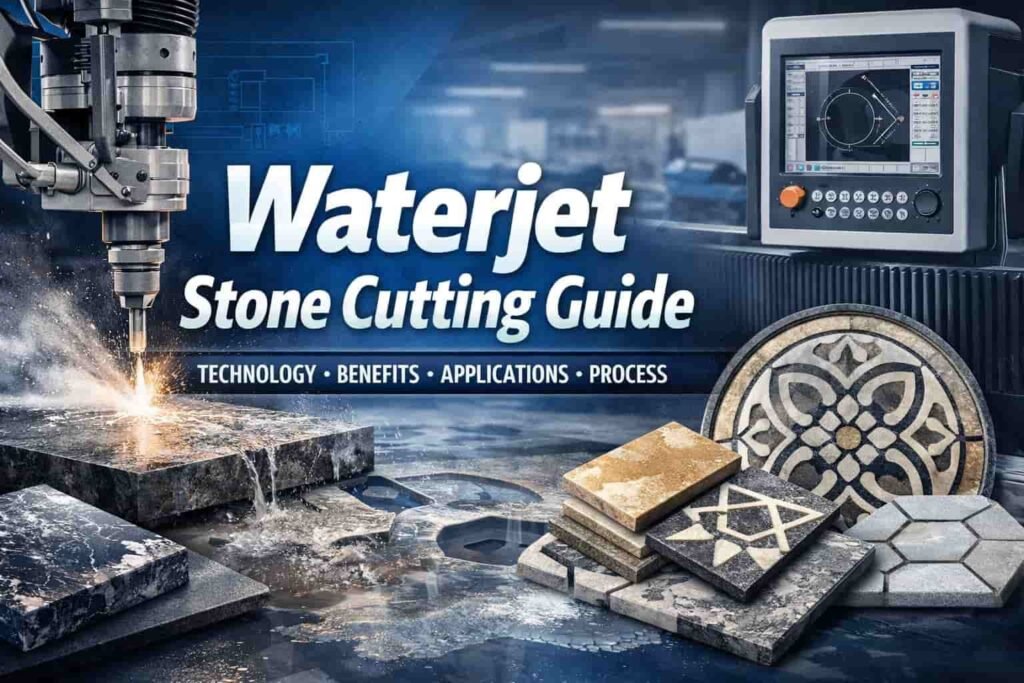
Waterjet stone cutting is a modern way to cut stone and tiles using a strong stream of water, sometimes mixed with a grit material. Unlike regular saws, it does not make heat, so the stone does not crack or get damaged.
This method makes it easy to cut stones into any shape or design. It is often used for marble counter-tops, decorative designs, and many home and business projects. In this waterjet stone cutting guide blog, we will inform you through the basics, benefits, and applications of waterjet stone cutting.
Applications include:
- Marble, granite, and limestone slabs
- Engineered stones like quartz and porcelain
- Slate and ceramic tiles
What is Waterjet Stone Cutting Technology?
Waterjet stone cutting is a modern way to cut stone, tiles, and other hard materials using a strong stream of water, sometimes with small hard particles. Unlike saws or lasers, it does not make heat, so the stone stays whole without cracking or changing color.
Here’s a detailed breakdown:
How Waterjet Cutting Works
Waterjet cutting uses very strong water jets, sometimes over 60,000 PSI, to cut materials. When mixed with hard particles like garnet, it can cut even very hard stones accurately. Unlike lasers or other heat-based cutting, waterjet cutting does not produce heat. This keeps the stone safe from cracks and gives smooth edges.
Types of Waterjet Cutting Systems
- Pure Waterjet Cutting: Involves the use of high-pressure water to cut materials only. This method should be used for soft stones or fragile work pieces as it is not harmful to the material.
- Abrasive Waterjet Cutting: Performed by incorporating a material of garnet into the water. This causes the cutting to be stronger and also enables it to cut hard stones such as granite and quartz with ease.
- CNC Waterjet Machines: These are computer-controlled and are able to trace detailed patterns and repeat the same pattern multiple times without errors. This renders them ideal for complicated forms and repetitive work.
Materials Suitable for Waterjet Stone Cutting
Waterjet cutting works for a variety of materials:
- Natural Stone: Granite, marble, limestone, travertine.
- Engineered Stone: Quartz, porcelain slabs.
- Ceramic & Mosaic Tiles
- Considerations: Thickness and hardness influence cutting speed and machine settings.
Advantages of Waterjet Cutting for Stone & Tile Fabrication
- Precision & intricate detailing: Waterjet cutting is highly precise, and it can be used in logos, patterns, and inlays, and it provides the opportunity to make very precise cuts on stone and tiles.
- Smooth, chip-free edges: This results in clean, chip-free edges, so less time is required to finish or polish the stone.
- No heat-affected zones: Waterjet cutting is not heat-based and, therefore, the stone does not weaken and crack or change its color.
- Complex shapes & inlays: The machine will be able to cut curves, circles, and artistic shapes therefore making it easy to create custom shapes and decorative inlays.
- Reduced material waste: Waterjet cutting is efficient in terms of material waste, generating less scrap and saving more material from each slab.
Waterjet Stone Cutting vs Traditional Stone Cutting Methods
Bridge Saw vs Waterjet
Waterjet cutting can make detailed shapes, curves, and decorations that a bridge saw cannot. Bridge saws mainly cut straight lines, so they are not as flexible for custom designs.
Waterjet vs Laser Cutting
Laser cutting heats the stone, which can cause cracks, chips, or color changes. Waterjet cutting involves the use of cold water hence the stone remains strong, the edges are smooth, and there is no heat damage. This makes waterjet cutting less harmful to delicate or costly stones.
Waterjet vs CNC Router
CNC routers can work well on soft stones, but can have problems with extremely hard materials such as granite or quartz. Hard stones can be easily cut with waterjet tools, making clean, sharp cuts without damaging the machine or the material. It is also efficient with complicated patterns which a router cannot handle.
Applications of Waterjet Stone Cutting
- Custom stone inlays & medallions
- Decorative wall panels
- Counter-tops & backslashes
- Flooring & tile patterns
- Architectural & commercial projects
Waterjet Stone Cutting Process Step-by-Step
- The waterjet stone cutting process begins with the creation of a computer design. This demonstrates how the stone will be cut.
- Then, the stone is placed in the best position to use it efficiently.
- It is then loaded into the machine with the design, and the machine knows where to cut.
- The machine cuts the stone very carefully with high-pressure water, which at times includes an abrasive.
- Lastly, the work is checked and completed. The edges are smoothed, and the cuts are measured to ensure accuracy.
Accuracy, Tolerances & Design Capabilities
- Common tolerances: ±0.1 mm for complex designs.
- Minimum radius and detail limits: Achieves sharp details and tight curves.
- Naturalistic geometries and artistic designs: Enables medallions and mosaics.
- Repeatability: Ideal for mass production.
Cost of Waterjet Stone Cutting
The cost of waterjet stone cutting hinges on several basic factors. The nature of the stone matters since hard stones such as granite or quartz are expensive to cut as compared to soft stones. It also depends on the thickness of the stone.
The design influences the cost as well. Cuts that are straight are less expensive and detailed shapes and more time-consuming are expensive. Price also varies depending on the quantity of pieces, the more pieces, the cheaper price per piece.
Environmental & Safety Benefits
Waterjet cutting is less hazardous and environmentally friendly. It neither generates dust nor silica, which contributes to the safety of workers and the cleanliness of the place.
There is also minimal wastage of the materials since very little waste is generated through this way. This is more environmentally friendly. Waterjet cutting is non-hazardous to use indoors. It does not emit toxic smokes and pungent smells, making it suitable for indoor workshops.
Common Challenges & Limitations of Waterjet Cutting
Waterjet cutting is quite handy, and there are a couple of issues. The cost of the machinery is one of them. The price of a waterjet machine may be high particularly for a small company.
It is also slower when cutting very thick stone. Materials with greater thickness are harder to cut. The machine should also be taken care of regularly such as cleaning it and checking its parts to ensure that they are working well.
Waterjet cutting is not optimized to make numerous straight cuts that are simple in nature. In this kind of work traditional cutting machines can prove to be quicker and cost less.
How to Choose the Right Waterjet Stone Cutting Machine
It is significant to select an appropriate waterjet stone cutting machine in order to complete the task and save money. In the first place, consider the amount of cutting required. When there is so much work to be done, you should have a machine with the ability to work at high speed.
In the case of small-scale work, a small machine suffices. Then consider what kind of stone you want to cut. Such as granite and quartz require a more powerful machine but soft stones such as marble are easy to cut.
In addition, think about the extent of detail of your cuts. A CNC machine is preferable in fancy shapes or designs. Finally, check your budget. Add the machine cost, maintenance, and materials. This will help you choose the right machine for your work.
Conclusion
In this waterjet stone cutting guide blog, we have explained the basics of waterjet stone cutting, its advantages, and how it supports efficient stone and tile fabrication. Waterjet stone cutting is a reliable and precise method for cutting stone and tile with clean edges and minimal material waste.
It allows fabricators to create complex shapes and detailed designs without heat damage. By understanding how the process works, its benefits, and key considerations, businesses can make better fabrication decisions.
FAQs
A. Yes. It works on natural stones like granite and marble, engineered stones like quartz, ceramics, and tiles. Harder stones may take longer to cut.
A. Waterjet cutting is very precise and can cut within ±0.1 mm, which is great for detailed designs and patterns.
A. No. It is a cold-cutting method, so it does not create heat or cracks in the stone.
A. The machine costs more at first, but it saves money by reducing waste and finishing work, especially for detailed or custom cuts.
A. Yes. It is safe for indoor workshops because it produces very little dust or harmful particles.
