
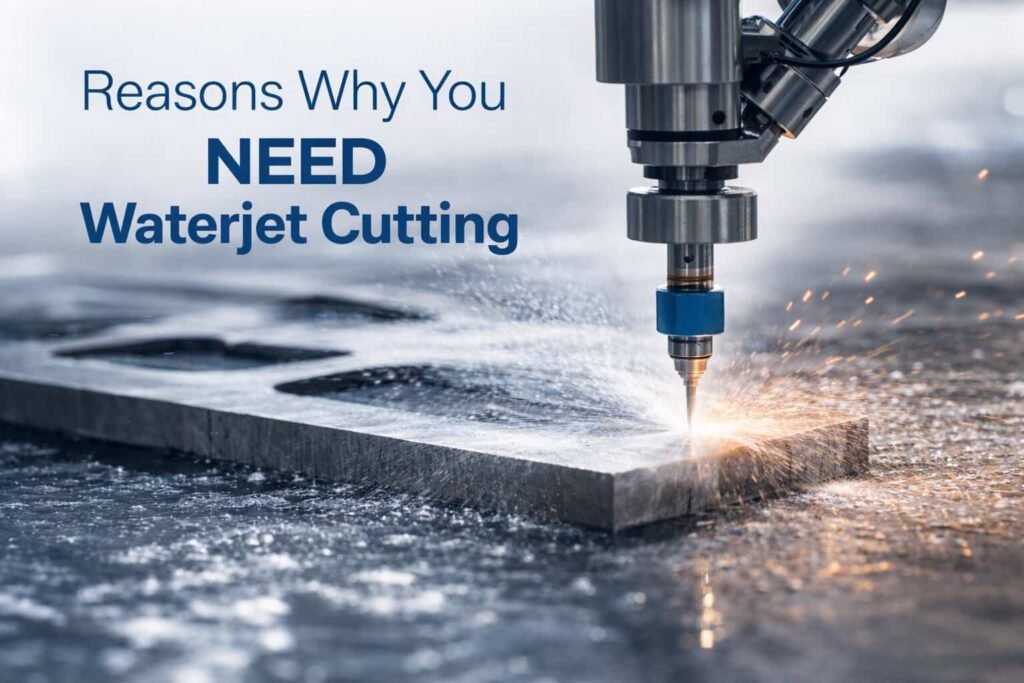
Waterjet cutting involves a high-pressure stream of water, typically combined with garnet abrasive, to cut materials with great precision. This procedure offers a complete cold-cutting operation, in that no heat-affected area is formed, since it is not based on heat like a laser or plasma system. Consequently, distortion is avoided, the material maintains its integrity, and dimensions remain precise.
It is currently popular in aerospace, automotive, medical, and architectural fabrication departments. Owing to its versatility in using varied materials and intricate designs with minimal waste, most fabrication teams use it daily.
Zero Thermal Distortion — Preserve Material Integrity
The greatest benefit is straightforward: it cuts without heat, and thus there is no thermal distortion or structural alteration. Conventional cutting techniques (e.g., laser or plasma) create heat that can distort or change the microstructure of materials. A high quality waterjet cutting machine does not do this; it uses only water pressure and abrasive particles rather than heat.
To illustrate, in aerospace manufacturing, aluminum or titanium components must retain precise mechanical qualities. Waterjet cutting ensures there are no heat-affected zones (HAZ); therefore, materials remain hard and homogeneous.
Cuts Almost Any Material
Some of the materials that can be processed by a single machine, without changing systems, include:
- Steel, aluminum, copper, and titanium
- Plastics and polymers
- Composites and laminates
- Glass and ceramics
- Stone and marble
Waterjet also creates clean and accurate cuts, unlike some systems that may break glass or damage ceramics. This flexibility allows a single machine to handle many types of projects, saving on the need for multiple cutting technologies.
Exceptional Accuracy and Tight Tolerances
Waterjet machines have control through CNC (computer numerical control) and therefore every cut may be pre-programmed to perfect specifications. Current CNC systems run between 60,000 and 90,000 PSI, which enables a tolerance of about ±0.1 mm, depending on the material.
As an example, accuracy is essential in the manufacturing of auto parts. The slightest variation will influence assembly or performance. Waterjet cutting assists parts to fit in the right manner and in a consistent way, thus minimizing errors and unnecessary wastages of materials.
Smooth Edges with Minimal Finishing
Another advantage is edge quality. Compared to laser or plasma cutting, which can leave rough or burnt edges, Waterjet generally provides a smooth and polished edge, so no further finishing is normally needed.
As an example, in signage making, when cutting thick acrylic sheet waterjet is advantageous, it can be cut to form clear and clean edges without sanding or polishing, thereby saving time and labor.
Ability to Cut Thick Materials
Waterjet cutting is not limited to thin sheets. It can cut very thick metals, stone slabs, and composites with the same accuracy. Laser and plasma systems may have a hard time cutting through thicker materials, and the production may be slowed or rough edges left behind.
This is the reason why it can be applied to heavy steel plates in construction equipment or to thick-layered composites in spacecraft.
Versatility in Cutting Shapes & Sizes
It is possible to cut intricate shapes, bevels, curves, and even 3D forms with multi-axis waterjet machines. This can be used especially in artistic designs, composite structures or in customized machine components.
The complicated curves, bevel cuts and finer lines can be done without spoiling the base material.
Reduced Material Waste
Waterjet has a narrow cutting width; as a result, it efficiently uses materials, generating less scrap which results in cost reduction, particularly when one has to deal with such costly metals as titanium or specialty composites.
One example is cutting complex patterns in an otherwise metallic sheet with waterjet, where layout coloring can be done to ensure that maximum useful material is used, potentially saving a significant amount of money on the payback of the entire project.
Safe and Environmentally Friendly
Waterjet cutting produces non toxic fumes, and there are minimal airborne particles compared to thermal cutting techniques. The processed water is usually recycled during operation, as is the case with modern systems. The abrasives are inert, and no chemical solvents or high-energy lasers are used in the process.
Waterjet cutting may be a viable option to manufacturers who aim to attain sustainability objectives. It helps in protecting the workers and the environment and does not reduce productivity.
High Production Efficiency
Waterjet machines are capable of handling small custom work and a production run with a large volume. Some systems can even slice through multiple stacked sheets at a time without reducing quality, while increasing throughput.
By having strict deadlines manufacturers are able to set the standards of quality without putting the manufacturing schedule behind.
Broad Industry Application
Waterjet cutting is used across a wide variety of industries:
- Aerospace- Cutting precise, heat-sensitive metals and composites.
- Automotive- Complex body panels and engine components.
- Architecture- Stone, metal, and decorative panels.
- Medical- Surgical instruments and implants.
- Defense- High-strength metals and armor.
For many fabrication businesses, this flexibility reduces the need for multiple cutting systems.
Conclusion
In the case of manufacturers handling materials that are sensitive to heat or those that have the highest value, this is the technology that addresses issues that cannot be addressed by thermal cutting. It maintains material integrity, minimizes waste, and operates on very disparate materials without posing any heat-related threat.
FAQs
Q. What materials can waterjet cutting handle?
It works on metals, plastics, glass, stone, ceramics, and composite materials.
Q. How precise is waterjet cutting?
Modern CNC-controlled systems can maintain tolerances around ±0.1 mm, depending on material and thickness.
Q. Is waterjet cutting environmentally friendly?
Many systems recycle water, and the garnet abrasive used is inert, producing no toxic fumes or hazardous dust during cutting.
