
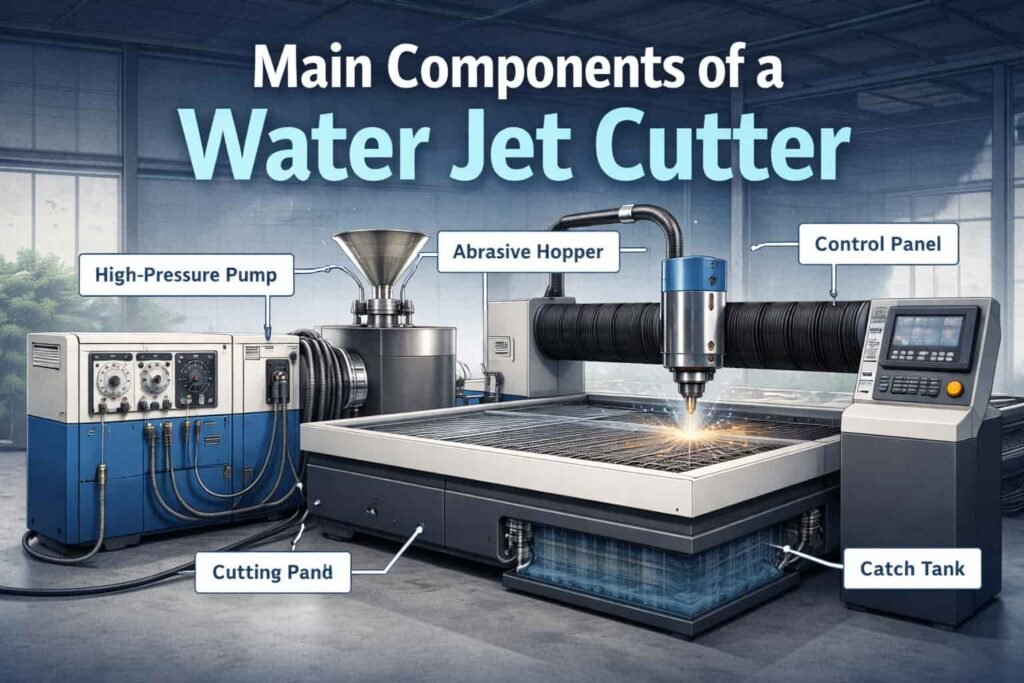
A water jet cutter is a precision machining device that is widely used in industries such as aerospace, automotive, stone fabrication, and metalworking. It is necessary to learn the key elements of a water jet cutter to ensure optimal functionality, proper cutting, minimized downtime, and long machine life.
Every component has a particular role similar to that of individual organs in the human body. When one component fails, efficiency and cut quality are impacted.
What Is a Water Jet Cutter?
A water jet cutter is a high-tech cutting machine that works ultra-high-pressure water, often combined with abrasive material, to cut a wide range of materials.
How Water Jet Cutting Works
- Water is pressurized to 60,000 PSI or greater.
- The high velocity stream is discharged via a small hole.
- When cutting hard materials such as stone or steel abrasives are added.
- The targeted jet has high accuracy, and the amount of heat generated is low.
Water jet cutting is a cold cutting process (contrary to laser or plasma cutting) and as such, heat-sensitive zones are avoided, and material distortion is minimized.
Core Components of a Water Jet Cutter
The core components of a water jet cutter are the main parts that create pressure, control movement, and perform the actual cutting process.
High-Pressure Pump
The water jet cutting machine consists of a high-pressure pump. It creates the force that is needed to propel water to the cutting speeds.
Types of Water Jet Pumps
Water jet pumps are responsible for generating the high-pressure water required for cutting, and different pump types are used based on cutting needs and workload.
Direct Drive Pump
A direct drive pump is of a small size and consumes less energy. It is used in light to medium cutting work. This type of pump is simple to maintain and is efficient for thinner materials and lower-pressure applications.
Intensifier Pump
An intensifier pump is made for heavy-duty cutting in industrial applications. It has the capability of cutting hard and thick materials of very high pressure. This type of pump is ideal in a continuous operation and applications that require high cutting power.
Electric Servo Pump
State-of-the-art motor control is used in an electric servo pump to deliver precise pressure and flow. It is a combination of greater accuracy and reduced power usage and thus is an efficient choice in the current water jet cutting systems.
Key Sub-Components
- Crankshaft
- Pistons
- Seals and check valves
Pump performance directly affects cut speed, accuracy, and operating costs.
Water Reservoir and Accumulator
Clean water is held in the water reservoir and pumped to the system. The reason why clean water is vital is that dirt or minerals may destroy internal components of the machine and lower the quality of cutting.
The accumulator assists in regulating the pressure of water in the system. It also flattens the pressure variation to ensure that the water moves consistantly during the cutting process. The accumulator can be compared to a shock absorber, it cushions the machine against sudden spikes in pressure and gives consistent cuts.
Abrasive Delivery System
Under abrasive water jet cutting, abrasive material, e.g. garnet, is added into the water stream. To add more cutting force, the abrasive provides the water jet with high cutting power particularly with hard materials such as metal or stone.
The system is made up of an abrasive hopper where the abrasive is stored, a metering system to determine the amount of abrasive used and tubing that directs the abrasive to the cutting head. Abrasive flow must be properly controlled, which results in clean edges, reduced taper, and faster cutting.
Control Valves and Flow Regulator
The control valves determine the timing of water flow and the amount of pressure released into the system. They are used to initiate and terminate the cutting process without difficulties.
The reason these valves are significant is that they maintain the pressure constant, enhance consistency and minimize the stress to significant machine components. Quality flow control leads to a uniform kerf width and less rippled cut surfaces.
Cutting Head Assembly
The actual cutting occurs on the cutting head of the machine. It sends the high-pressure water and the abrasive to the material.
It has a jewel opening that concentrates the stream of water, a mixing tube combining the abrasive to water and a nozzle that guides the cutting jet. Sapphire or diamond are other materials that are commonly used as they are more durable and assist in maintaining the cut accuracy.
High-Pressure Tubing
The pump sends pressurized water into high-pressure tubing that directs it to the cutting head. It is being subjected to extremely high pressure which it is required not to leak or fail.
This tubing is made to resist vibration and metal fatigue. High strength and durability of the tubing are essential in the safety of the operator and performance of the system in the long run.
Gantry and Motion System
The gantry system is used to move the cutting head on the X and Y directions of the material. It regulates the position and manner through which a cut is done.
Servo motors allow movement to occur smoothly and in a controlled manner and linear guides allow the act to be correctly positioned. The cutting accuracy and repeatability are directly related to the quality of the gantry system.
Supporting and Safety Components
Supporting and safety components help the water jet cutter operate smoothly, safely, and reliably during daily use.
CNC Controller
A CNC controller is the brain of a CNC water jet cutter. It regulates the movement and cutting of the machine depending on the programmed instructions.
It operates cutting programs, manages the speed and water pressure, and navigates the cutting head along the correct path. This enables the machine to make intricate shapes and to position numerous components tightly next to each other in order to minimize wastage of materials.
Cutting Table
The material is held by the cutting table during a cutting process. It also gives a stable surface which supports various sizes and types of workpieces.
The vast majority of cutting tables are slatted or submerged. These designs assist in decreasing the vibration, the sound and enhance the overall cutting precision.
Catcher Tank and Drainage System
The tank used to catch is placed beneath the cutting table. It gathers used water and abrasive-laden material following the cutting process.
This system captures the excess energy of the water jet and limits splashback as well as it prevents any damage by the high pressure water on the adjacent machine parts.
Filtration and Water Treatment Systems
It is very important that a water jet cutter has a long life which is served by clean water. The filtration systems eliminate dirt, particles and minerals in the water.
These systems ensure that the orifice and seals are not damaged by ensuring that the water is kept clean. They also assist in the prolongation of the life of the high-pressure pump and lowering the cost of maintenance.
Chiller (Coolant System)
Heat is generated when high-pressure pumps are operating. This heat is regulated by the use of a chiller system.
It maintains the pump operating temperature at the correct level, seals do not fail, and the system overall works better. This aids the machine to run longer without any problem.
Safety Systems
The contemporary water jet cutters have several safety features built in to ensure the protection of the operator and the equipment.
These are the emergency stop buttons, the pressure sensors and the protective enclosures. All these systems contribute to safe operation and compliance with industrial safety standards.
Advanced Precision Components
Advanced precision components enhance cutting accuracy, improve finish quality, and allow the machine to handle complex cutting tasks.
Height Sensors (2D and 3D)
Height sensors automatically keep the correct distance between the cutting head and the material surface. This is important because materials are not always perfectly flat.
These sensors adjust the cutting head when the material is warped or uneven. This improves edge quality, prevents nozzle damage, and helps maintain consistent cutting results.
Positioning Laser
A positioning laser helps operators place the material correctly before cutting begins. It shows exactly where the cut will start.
By improving alignment, the laser reduces setup time and lowers the risk of mistakes. This also helps minimize material waste and improves overall efficiency.
Bevel or Angled Cutting Head
Bevel or angled cutting heads allow the machine to cut at angles instead of only straight cuts.
These heads make it possible to create angled edges and complex 3D shapes. They also produce precise bevel cuts without the need for extra machining steps.
Auxiliary and Efficiency Enhancers
Modern water jet cutters include additional features that improve productivity and reduce operating costs.
Recyclable abrasive systems help reuse abrasive material, energy-efficient pumps reduce power consumption, and automated abrasive removal systems simplify cleanup and maintenance.
Conclusion
Understanding the main components of a water jet cutter is crucial for selecting the right machine, improving cutting performance, and minimizing operational costs. From the high-pressure pump to advanced precision sensors, each component contributes to accuracy, efficiency, and reliability.Manufacturers like Wamit Waterjet integrate these components into strong systems designed for long-term industrial performance and consistent cutting quality.
