
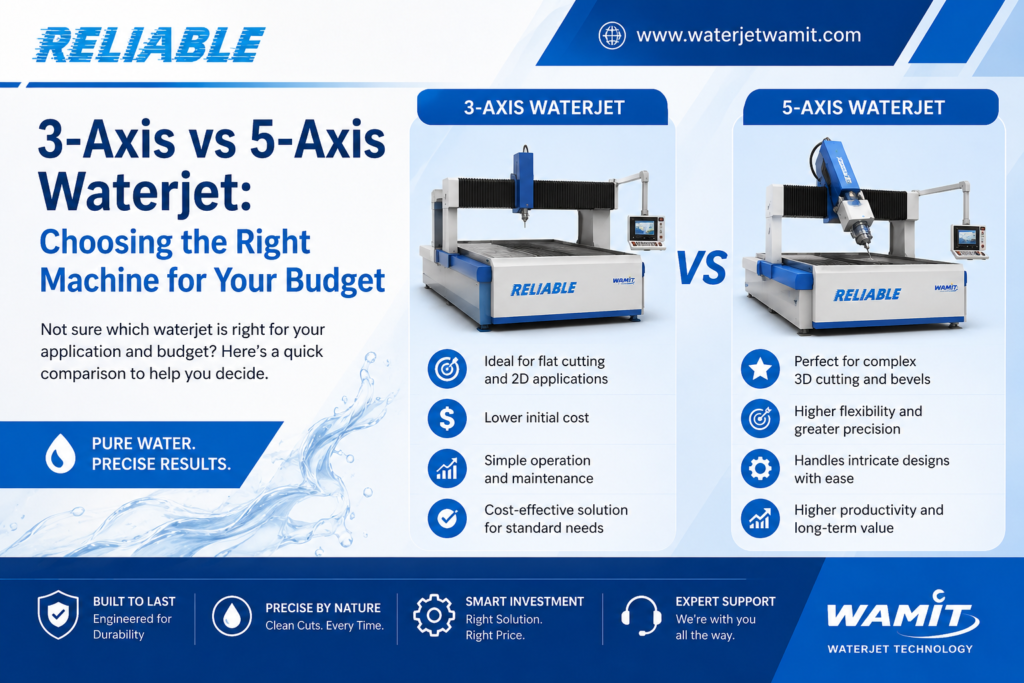
The inappropriate equipment in precision manufacturing does not simply cost you some time, but it is a profit killer. Whether it is metal, stone, or composites, waterjet technology is the most versatile. However, the main issue here is this: are you supposed to invest in a 3-axis system or upgrade to a 5-axis machine? This decision involves technical aspects, financial implications, and strategic considerations. The right choice can improve work processes and decrease waste while creating new business opportunities. The wrong one? It may end up wasting costly capabilities or reducing your own growth potential. Here we will divide it into straightforward steps to ensure that you make a decisive ROI-based decision.
What is a 3-Axis Waterjet Machine?
It would be good to know what a 3-axis system is and how it is applied in contemporary fabrication before making the comparison. A 3-axis waterjet machine is a machine that runs on three linear axes, X, Y, and Z. The machine creates vertical cuts because it operates with an up-and-down motion that works best for cutting flat surfaces.
Key Characteristics of 3-Axis Machines:
- Best at cutting 2D and simple profiles.
- Lower upfront investment
- Less maintenance and operation.
- Widely used in sheet metal, glass, and stone industries
When you are producing high-volume, flat-part products, then a 3-axis arrangement tends to provide the best cost-to-output ratio.
What is a Waterjet Machine 5-axis?
The advanced option demonstrates increasing popularity within high-precision fields. The 5-axis waterjet machine enables operators to perform rotational cutting through its A and B axis movements, which let the cutting head execute both tilting and rotational cutting. The system enables operators to create complex shapes through its capability to execute angled cuts, which exceeds the abilities of a 3-axis system.
Key Capabilities of 5-Axis Machines:
- Accurate beveling and taper offsetting.
- Possibility to develop 3D shapes and contours.
- Best in aerospace, automotive, and high-tech fabrication.
- Reduces need for secondary machining
The system provides powerful capabilities at higher costs which require users to invest time for complete proficiency.
3-Axis vs 5-Axis: Key Differences That Impact Your Budget
The choice between these two options requires you to select which option best matches your business operations.
| Factor | 3-Axis Waterjet | 5-Axis Waterjet |
| Cost | Budget-friendly, If you are looking to start without investing a huge amount | Costly initially but designed for professional use. |
| Ease of Use | Easy to operate | Requires skill to operate effectively. |
| Cutting Style | Straight cuts on flat materials—does the basics really well. | Cuts at angles and shapes accurately. |
| Best For | For everyday tasks and large-scale manufacturing operations. | For high-quality projects that require attention to detail. |
| ROI | faster paybacks for repetitive tasks | Pays off only if you consistently use its advanced features. |
When your projects do not require angular accuracy, then it is usually more cost-effective to invest in a 3-axis machine.
When Should You Choose a 3-Axis Machine?
Complexity is not always required by every business; sometimes efficiency is what matters most.
Considerations of a 3-axis system include:
- Your work involves flat sheets and 2D profiles
- You desire less initial investment.
- Your team likes to work with soft operation and maintenance.
- You focus on mass production and not personalization.
A 3-axis solution can fulfill 80-90% of daily cutting requirements with no unnecessary overhead for many manufacturers.
When Does a 5-Axis Machine Make Sense?
The 5-axis machine becomes necessary when advanced capabilities create essential operational requirements.
Choose 5-axis if:
- You work with parts that have both bevels and angles.
- Your clients need components that require high precision.
- You want to remove the need for additional machining steps.
- Your business wants to enter premium markets that offer high profit margins.
When such needs are not frequent but occasional, a 3-axis machine is more cost-effective.
Conclusion
Choosing between a 3-axis and 5-axis waterjet machine requires more than evaluating features because you must select equipment that matches your operational requirements. Excessive investment in unnecessary capabilities will reduce your profits while insufficient investment will restrict your business expansion. Invest wisely in the present – because the right machine not only cuts but also generates income! Shenyang Reliable Technology Co. will provide you with professional advice on selecting the appropriate equipment for your needs, from a 3-axis waterjet machine or beyond.
FAQs
Is a 3-axis waterjet enough for most businesses?
Yes, a 3-axis waterjet meets the requirements for standard cutting work which is common in sheet metal and stone fabrication industries.
What is the main advantage of a 5-axis waterjet
The main advantage of 5-axis waterjet systems enables operators to create angled and complicated cuts, which decreases their need for additional manufacturing procedures.
Can a 3-axis waterjet cut thick materials
A 3-Axis machine enables operators to cut through heavy materials, but it does not provide the ability to create angled edges or bevel cuts.
